How to get rid of rats
A rat in the house is rarely a one-off. Where one has found food, water and a way in, more will follow, and they breed fast. This guide explains what you are likely to see, why the rats chose your property, the options open to you, and what happens when a technician treats it.
Key points
- Rats come in for food, water and cover, and in a house the route is usually a broken or redundant drain.
- Take away the food and the shelter first, because no treatment holds if the reasons they came remain.
- Shop-bought poison rarely clears an infestation because it is weak, sold in small packs and often put in the wrong place.
- A professional treatment is usually 2 to 3 visits over 2 to 3 weeks, with bait in tamper-resistant stations and a search for carcasses.
- The job is finished when the signs stop and the entry point is sealed, not when the first rat is dead.
How to get rid of rats: the short answer
Find out what is bringing them in, take it away, and block the route they use. Then deal with the rats that are already inside with a treatment that is checked and followed up. Each part matters. Kill the rats without finding the way in and the next ones arrive within weeks. Seal the gap while rats are still inside and you shut them in the building.
Most people try the quickest thing first, which is a tray of poison from the hardware shop. It is cheap and it feels like action. The trouble is that it rarely ends the problem, for reasons covered further down. Rats are cautious, they breed quickly, and a bait tray does nothing about the drain they came up through.
If you want the short version of what works, it is this. Clear the food and the cover, get a rat treatment that includes follow-up visits, and have the entry point proofed once the technician has found it. The rest of this guide explains each step so you can decide how much of it to do yourself.
What a rat problem looks like
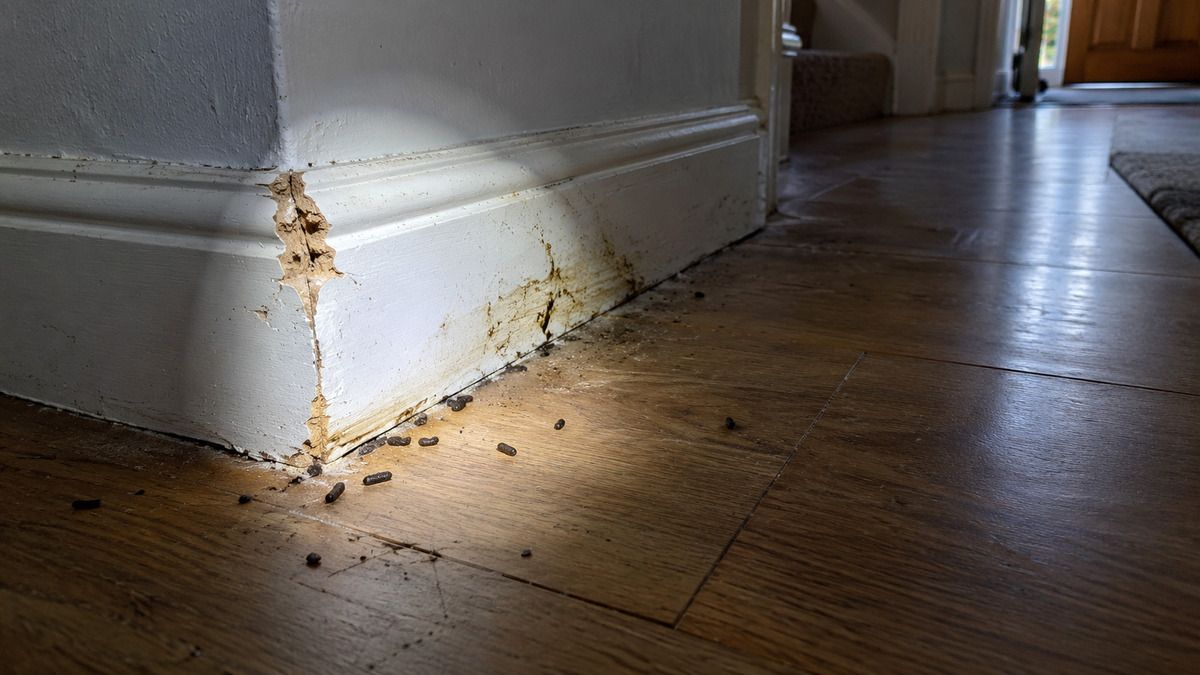
The first sign is usually droppings. Rat droppings are dark, about the size of a large grain of rice or a little bigger, and often blunt at one end. You find them along the edges of a room, behind the freezer, under the sink or in the garage. Fresh ones are soft and shiny. Old ones are dry and dull.
Next come the noises. Rats are mostly active at night, so scratching or scurrying in the ceiling, behind the bath panel or under the floor after dark points to rats or mice rather than squirrels. You may also notice gnawed packaging in a cupboard, a greasy smear where fur has rubbed along a wall, or a sharp, musky smell in a confined space.
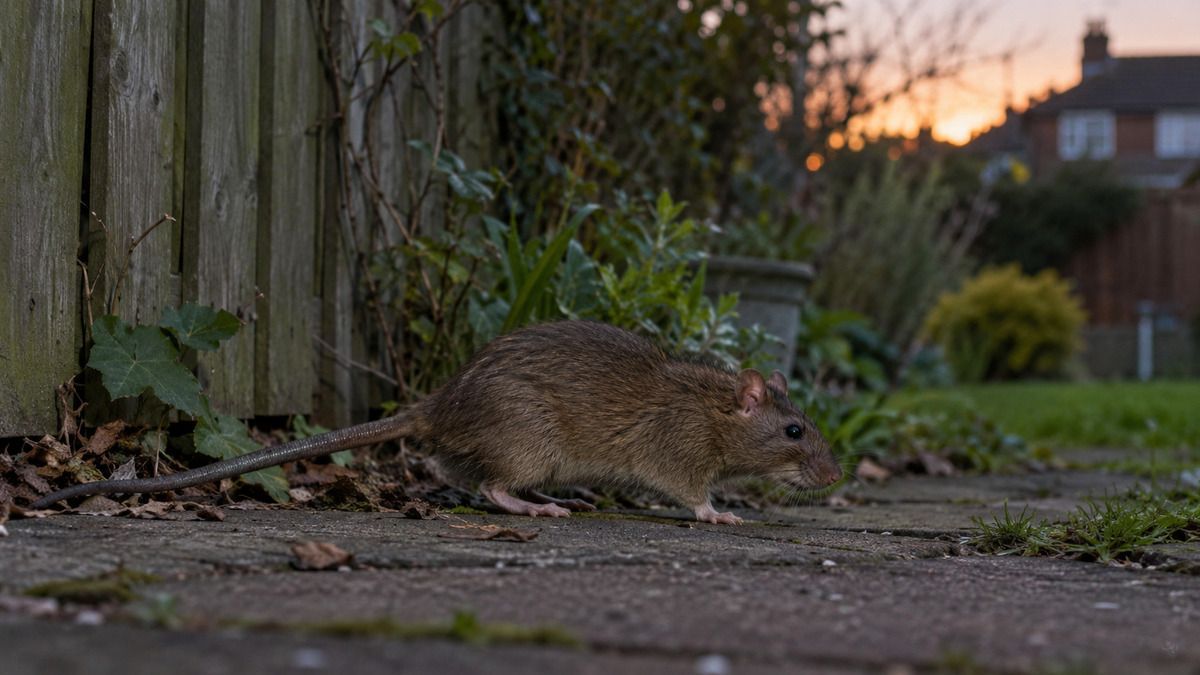
Outside, look for a hole about the width of a tennis ball in a bank, under a shed or beside decking, with smooth, worn earth at the mouth. A rat seen in daylight by the bins usually means the population is large enough that some are being pushed out to feed when they would rather not.
Found droppings or heard scratching?
Describe what you have found and where, and we reply by email with one fixed price for the whole rat treatment, follow-up visits included.
Why the rats are there
Rats need three things: something to eat, something to drink and somewhere to hide. A property that provides all three will attract them, and one that provides two is still worth a visit. Bird seed under a feeder, a compost bin with cooked food in it, a chicken run, pet food left out overnight and an overflowing bin are the usual sources.
Cover is the part people forget. Decking, a shed on a timber base, a pile of logs or a bank of ivy gives a rat a place to burrow where nothing disturbs it. Our page on rats in the garden and shed goes through this in more detail.
The way into the house is most often a drain. A cracked pipe under the floor, a disused run from an old outside toilet, a missing cover on a rodding eye or a damaged interceptor trap gives rats a dry tunnel straight into the building. Gaps under doors, broken airbricks and holes where pipes pass through walls come next. A rat needs a gap no wider than your thumb.
Your options, from doing nothing to a professional treatment
Doing nothing is an option, though not a good one. Rats breed throughout the year, so a small problem becomes a large one quickly, and gnawed cables and fouled insulation are expensive to put right. Removing the food and cover costs nothing and should be done whatever else you decide. Move the bird feeder, lid the compost, store pet food in a sealed tub and clear the clutter behind the shed.
Traps can work on a single rat if you know where it runs, though rats avoid anything new in their territory and may walk past a trap for days. Any trap you set must be an approved type and checked regularly. Glue traps are not an option for the public in England, Wales or Scotland, and we do not use them. Shop poison is the other common route. The products on sale to the public are weaker than professional rodenticides, come in small packs and are usually placed where the rats are not feeding, so they rarely clear an infestation. Some rat populations are resistant, others become bait shy, and loose bait is a risk to pets and wildlife. There is more on this in why shop-bought rat poison rarely works.
Your council may offer a pest control service, usually for a charge and with a waiting time, though some councils have stopped. The Prevention of Damage by Pests Act 1949 obliges councils to keep their districts free of rats and mice, which is why they can also require a property owner to act. See does the council do pest control for how to check. The last option is a professional treatment, which is what we do.
What a professional treatment involves
You tell us what you have seen and heard, where the droppings or the hole are and when it started, and we reply by email with one fixed price for the whole treatment. That figure covers the first visit and the follow-ups, with nothing added on the day. Proofing is quoted separately on the first visit, because nobody can price a repair before they have seen what needs repairing. We only use one national company, which is a BPCA member and CPD registered, holds ISO 9001 and British Safety Council certification, is SafeContractor approved and carries a waste carrier licence for England and Wales. Asking any firm whether it is a BPCA member is a fair question before you book.
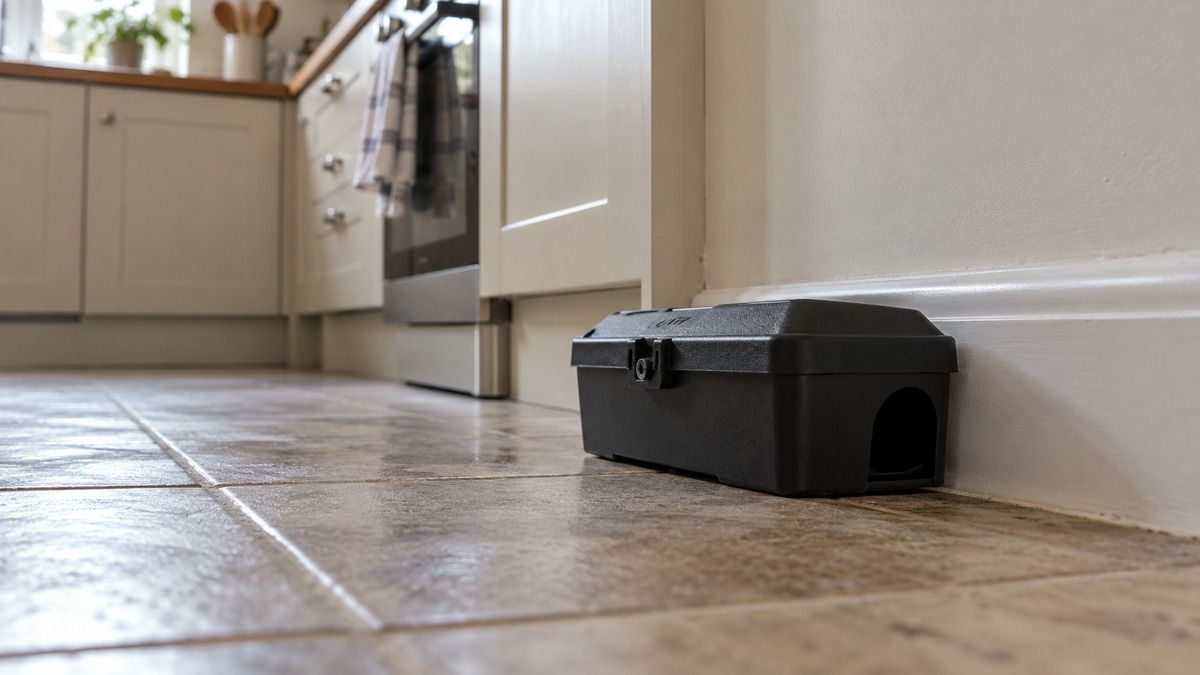
On the first visit the technician surveys the property, confirms from droppings, gnawing and tracks that you have rats rather than mice, and looks for the way in. Bait goes into tamper-resistant stations placed where the rats are active, never loose. You are told what to do between visits, such as keeping pets and children away from the stations and not clearing up droppings until they have been checked.
A standard treatment is typically 2 to 3 visits over 2 to 3 weeks. On each follow-up the stations are checked and refreshed, carcasses are searched for and removed, and any new signs are looked at. Rats are wary of new objects, so it can take days before bait is touched, which is why one visit is never enough. At the end you get a summary of what was found and what proofing would stop it happening again.
Rats and your health
Rats can carry leptospirosis, also known as Weil's disease, in their urine, and their droppings can carry salmonella. Hantavirus is rare in the UK. None of this is a reason to panic, but it is a reason to wear gloves when you clean up, to keep food out of reach and to wash your hands after touching anything a rat may have been over.
If you develop flu-like symptoms after contact with rats or with surfaces they have fouled, see a GP and mention the rats. Leave droppings in place until the technician has seen them, then follow the advice given on sanitising the area once the treatment is finished.
When it is done
The treatment is finished when the bait is no longer being taken, no fresh droppings appear, the noises stop and any carcasses have been removed. The technician confirms this on the final visit rather than assuming it. If activity continues, the plan is adjusted and another visit is arranged.
Then the proofing matters more than anything else. Steel mesh over gaps, cement around pipes, brush strips under doors and covers over airbricks keep the next rats out, and a damaged drain is repaired by a drainage contractor. Fix the route and clear the food, and a treated house usually stays clear.

Questions people ask
How long does it take to get rid of rats?
There is no fixed time, because it depends on how many rats there are, where they are feeding and how quickly they accept the bait. A standard treatment is usually 2 to 3 visits over 2 to 3 weeks, and the technician confirms on the final visit that the activity has stopped.
Can I get rid of rats myself?
You can remove the food and cover yourself, and you can set approved traps that you check regularly. What is hard to do alone is find the entry point, often a drain under the floor, and keep bait in the right place long enough for cautious rats to take it.
Will rats go away on their own?
Rarely. If food, water and shelter are still there, they stay and breed. Taking away the food source sometimes moves them on, but a rat that has found a dry route through a broken drain tends to keep using it until it is repaired.
Why do I need follow-up visits?
Rats avoid new objects, so bait stations can sit untouched for days before feeding starts. The follow-ups refresh the stations, remove carcasses and check for new signs. A single visit only shows whether the stations were placed well, not whether the problem is over.
Ready for a fixed price?
Tell us what you have seen and heard using the form, with your postcode and when it started, and we reply with a price for the first visit and the follow-ups.
- Fixed price by email
- Follow-up visits included
- A BPCA member contractor
- Next day where possible

Get a fixed price for the treatment
Tell us what you have seen and heard, where, and when it started, and we reply by email with a fixed price for the whole treatment.
Sent.
Prefer to write? Email hello@rodent-control.uk with your postcode, your phone number and what you have found.