How to get rid of mice
Mice are smaller than rats, bolder, and far better at getting through tiny gaps, which is why a kitchen can go from spotless to full of droppings in a fortnight. This guide covers how to tell them from rats, the signs to look for, what you can do yourself, and how a treatment with follow-up visits works.
Key points
- A house mouse squeezes through a gap the width of a pencil, so proofing has to be thorough to work.
- Mice are curious and investigate new objects within hours, which is the opposite of how rats behave.
- Snap traps set along walls and checked regularly can catch the odd mouse, but they do not find where the mice are coming from.
- Shop poison rarely clears mice for the same reasons it rarely clears rats: it is weak, small and badly placed.
- In a flat or terrace the mice often live in the shared voids, so treating one home without the neighbours rarely holds.
How to get rid of mice: the short answer
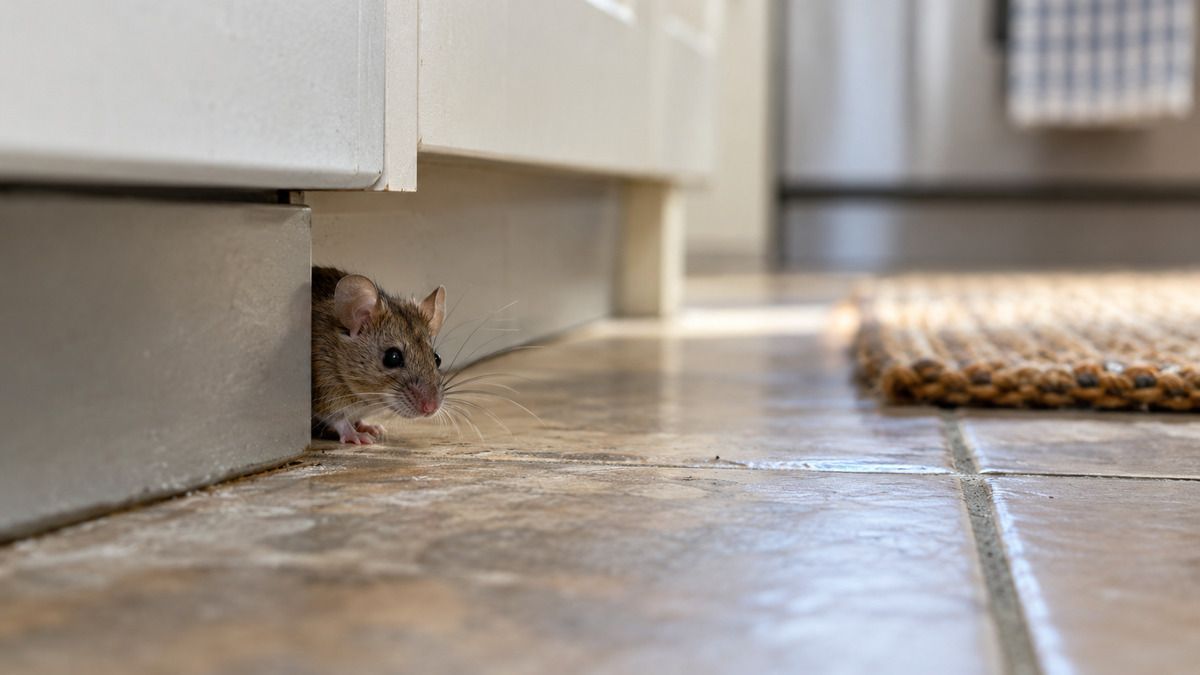
Cut off the food, close the gaps, and remove the mice that are already inside with traps or a treatment that is followed up. Mice are easier to catch than rats because they are inquisitive, but they are harder to keep out because they fit through almost anything. A pencil-width hole under a kitchen unit is a front door to a mouse.
Breeding is the reason speed matters. A female house mouse can have several litters a year, each of five or more young, and those young breed within a couple of months. Two mice in October are a colony by spring if nothing is done. Acting on the first droppings is far cheaper than acting on the hundredth.
The approach we recommend is the same whether you do it yourself or ask for a mouse treatment: store food so it cannot be reached, deal with the mice inside, then proof the building so the next ones stay out.
How mice differ from rats
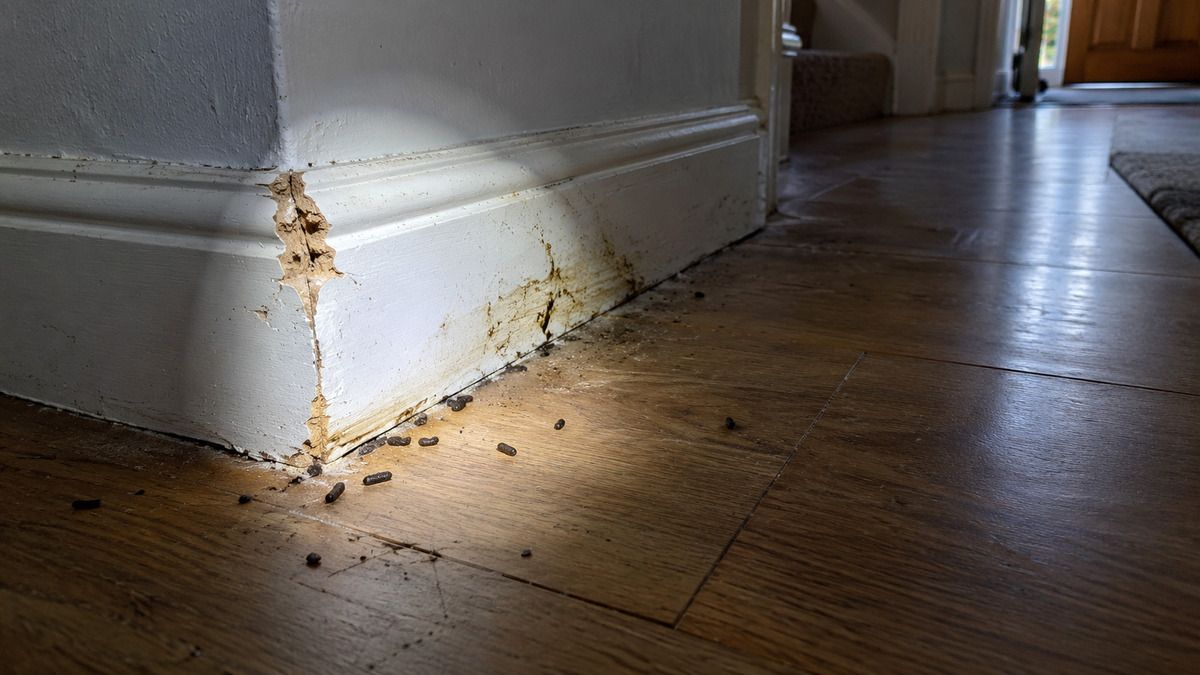
Size is the obvious difference. An adult house mouse is about the length of your thumb with a tail as long again, while a brown rat is several times heavier with a thick body and a tail shorter than its length. Mouse droppings are small and pointed, like grains of black rice. Rat droppings are bigger and blunter.
Behaviour matters more for getting rid of them. Rats are suspicious of anything new and may avoid a trap or station for days. Mice do the opposite. They explore anything that appears in their territory, often the same night, which is why a well placed snap trap can catch a mouse within hours.
Mice also need less. They get most of their water from food, so a dry loft or a wall cavity suits them. They nibble little and often rather than eating a lot in one place, which means droppings turn up all over the house instead of in a few spots. Gaps the width of a pencil let them in, where a rat needs the width of a thumb.
Droppings in the kitchen again?
Tell us what you have found and where. We reply by email with one fixed price for the mouse treatment, with the follow-up visits already included.
Signs you have mice
Droppings are the giveaway, and you will find them in drawers, along the back of worktops, in the cupboard under the sink and around the toaster. Mice leave dozens a day, so a kitchen that was clean last week and has droppings in three places now has an active mouse. Gnawed corners on cereal boxes and bags of flour are the other common sign.
At night you may hear light scratching or scampering in the ceiling or behind the kickboards, and a musty, ammonia-like smell builds up where mice have been nesting. Shredded paper, insulation or fabric packed into a corner of a drawer or the back of the airing cupboard is a nest. The guide to signs of rats or mice in your house goes through all of this in more detail.
Your options, from the cupboard to the council
Start with food. Mice live on crumbs, so sweeping the floor each night, keeping cereal and pet food in sealed containers and clearing the toaster tray takes away most of what they eat. Doing nothing else is a mistake, but doing this and nothing else sometimes reduces a small problem to an occasional visitor.
Snap traps are legal for the public to use, must be checked regularly, and work best set along the walls where mice run rather than in the open middle of a room. They are good for the odd mouse. They do not tell you where the mice are getting in, and in a bigger infestation the catches continue week after week. Glue traps are not an option for the public in England, Wales or Scotland, and we never use them. Shop poison is weaker than professional rodenticide, sold in small packs and often put where the mice are not feeding, so it rarely finishes the job and it can poison pets or wildlife. We cover this in why shop-bought rat poison rarely works.
Your council may offer a pest control service for mice, often for a charge and with a waiting time. Some councils no longer provide one. The alternative is a professional treatment, which is what the rest of this guide describes.
What a mouse treatment involves
You fill in the form with where you found the droppings or the gnawed packet and when the noises start, and we reply by email with one fixed price for the whole treatment. The follow-up visits are in that price and nothing is added on the day. Proofing is quoted separately on the first visit, once the technician has found where the mice are getting in. The company that does the work is a BPCA member and CPD registered, holds ISO 9001 and British Safety Council certification, is SafeContractor approved and has a waste carrier licence for England and Wales. Whoever you book, BPCA membership is a reasonable thing to ask for.
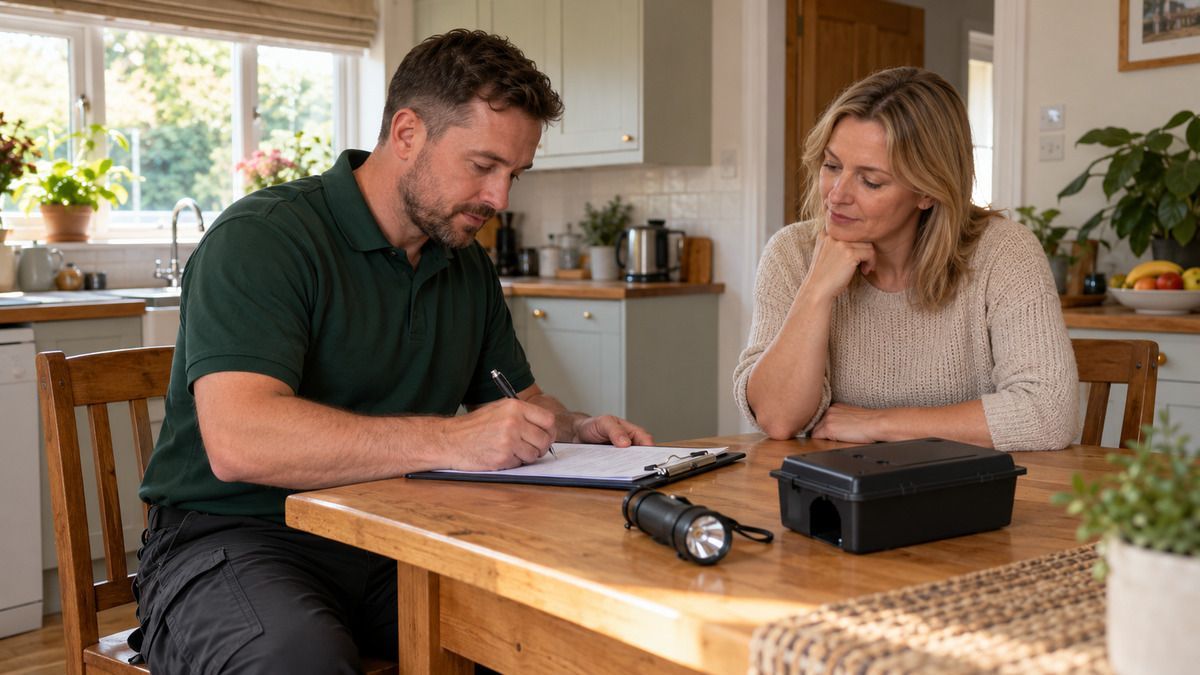
The first visit is a survey. The technician confirms from droppings, gnawing and tracks that you have mice rather than young rats, looks for the entry points, and places tamper-resistant bait stations or traps where the activity is. You are told what to do between visits, which usually means keeping food sealed, keeping pets away from the stations and leaving any new droppings for the next inspection.
Because mice investigate quickly, the first follow-up often shows a lot of activity in the stations. Over a typical 2 to 3 visits across 2 to 3 weeks the stations are checked and refreshed, carcasses are searched for and removed, and fresh signs are compared with the first visit. At the end you get a summary of what was found and what proofing would keep them out, such as steel mesh behind the kickboards and sealant around pipes.
Flats and terraces: when the mice are not only yours
In a converted house, a block of flats or a terrace, mice rarely live in one home. They run through the shared voids, under the floorboards and up the cavity walls, and treat the whole building as one territory. You can clear your kitchen and find new droppings a fortnight later because the colony next door was never touched.
Tell us if you live in a flat or a terrace, and whether the neighbours have mentioned mice. The technician looks at where the mice come from as well as where they feed, and the treatment and proofing are planned with that in mind. Landlords and letting agents sometimes ask for the whole building to be treated at once, with a written report after each visit, which is simpler for everyone. Mice that have moved up into the roof space are covered on our rats and mice in the loft page.
When it is done
A treatment is finished when there are no fresh droppings, nothing is being taken from the stations, the night noises have stopped and any carcasses have been found and removed. The technician checks each of these on the final visit instead of assuming the quiet means the mice have gone.
Proofing is what keeps it that way. A mouse that finds a pencil-width gap around a waste pipe will use it, so every hole the technician found is sealed with mesh, cement or sealant, brush strips go under doors and airbricks get covers. Keep the food sealed afterwards, and a proofed house rarely has the problem twice.

Questions people ask
How do I know if it is mice or rats?
Look at the droppings. Mouse droppings are small and pointed, about the size of a grain of rice, and turn up in large numbers all over the kitchen. Rat droppings are larger, blunter and found in fewer places. If you are not sure, describe their size and where they turn up and we will tell you.
Do snap traps work for mice?
They catch individual mice, especially when set along a wall where mice run and checked regularly as the law requires. What they cannot do is find the gap the mice are using or deal with a colony living in the wall cavity, which is why a treatment with follow-up visits usually finishes what traps start.
Why do the mice keep coming back?
Usually because the entry point was never sealed, or because the mice live in a shared part of the building. In a flat or terrace the colony may be next door or under the floor, so treating one kitchen on its own gives a short break rather than an end to it.
Is it safe to have bait stations with a cat or dog in the house?
The stations are tamper-resistant and are placed where mice run and pets do not reach, such as behind kickboards and in voids. Mention your pets when you fill in the form and the technician plans the placement around them. Bait is never left loose in a home.
Get a price for a mouse treatment
Use the form to tell us where the droppings are and whether you live in a flat or a terrace, and we reply with a fixed price and the earliest visit we have.
- Fixed price by email
- Follow-up visits included
- A BPCA member contractor
- Next day where possible

Get a fixed price for the treatment
Tell us what you have seen and heard, where, and when it started, and we reply by email with a fixed price for the whole treatment.
Sent.
Prefer to write? Email hello@rodent-control.uk with your postcode, your phone number and what you have found.